

Somewhere in my closet there is a basket of sunglasses that failed. One pinched behind my ears after twenty minutes. One slid down my nose every time I bent over. One was wide enough that it made my face look like it kept going after my hairline stopped. Not one was a bad pair of sunglasses. They were bad fits, and I bought all three because I liked them on the rack instead of on me.
I wore reading glasses for years before I gave sunglasses this much thought. Then I started walking downtown most mornings here in Asheville, and I needed a pair I could keep on for a mile without a headache or a squint. That is a different question from whether a pair looks nice in a display case. It took me a dozen try-ons at a drugstore counter to understand that fit is mostly geometry, and geometry is not mysterious once you know what to measure. I ended up in the small round polarized frame from SOJOS, and the reason was not style. It was width and bridge.
The pair that finally stayed on my face
Small round, polarized, and rated 4.4 across nearly twenty thousand reviews. I wore mine for a full morning walk the first day and forgot I had them on, which is the only review that ever matters to me.
Amazon Check Today's Price on Amazon →Five Steps to a Frame That Fits
Step 1: Find your face shape with your hair back
Pull your hair back, take off your reading glasses, and stand in front of a mirror in good light. Look straight at yourself without smiling, because a smile changes the shape of your jaw. Then trace the outline of your face on the mirror with a dry erase marker, or take a photo straight on and trace it on paper. The outline is easier to read than your face is, because you have been looking at your face your whole life and you stopped seeing it years ago.
Most faces fall into one of five rough groups. Round faces are close to the same width and length with a soft jaw. Square faces have a strong jaw and a wide forehead. Oval faces are a little longer than wide with balanced features. Heart shaped faces are wider at the forehead and narrow toward the chin. Long faces are noticeably longer than they are wide. Almost nobody is a pure version of one. I am longer than I am wide with a square jaw, which puts me between oval and square.
If you cannot tell, use your phone camera. Take a photo straight on, then look at it later on a bigger screen. Photos flatten a face and make the outline obvious, which is why every passport photo you have ever had makes you look like a different person. The outline in that photo is the honest one. Write down the word you land on, because that single word will save you more money than any sale.
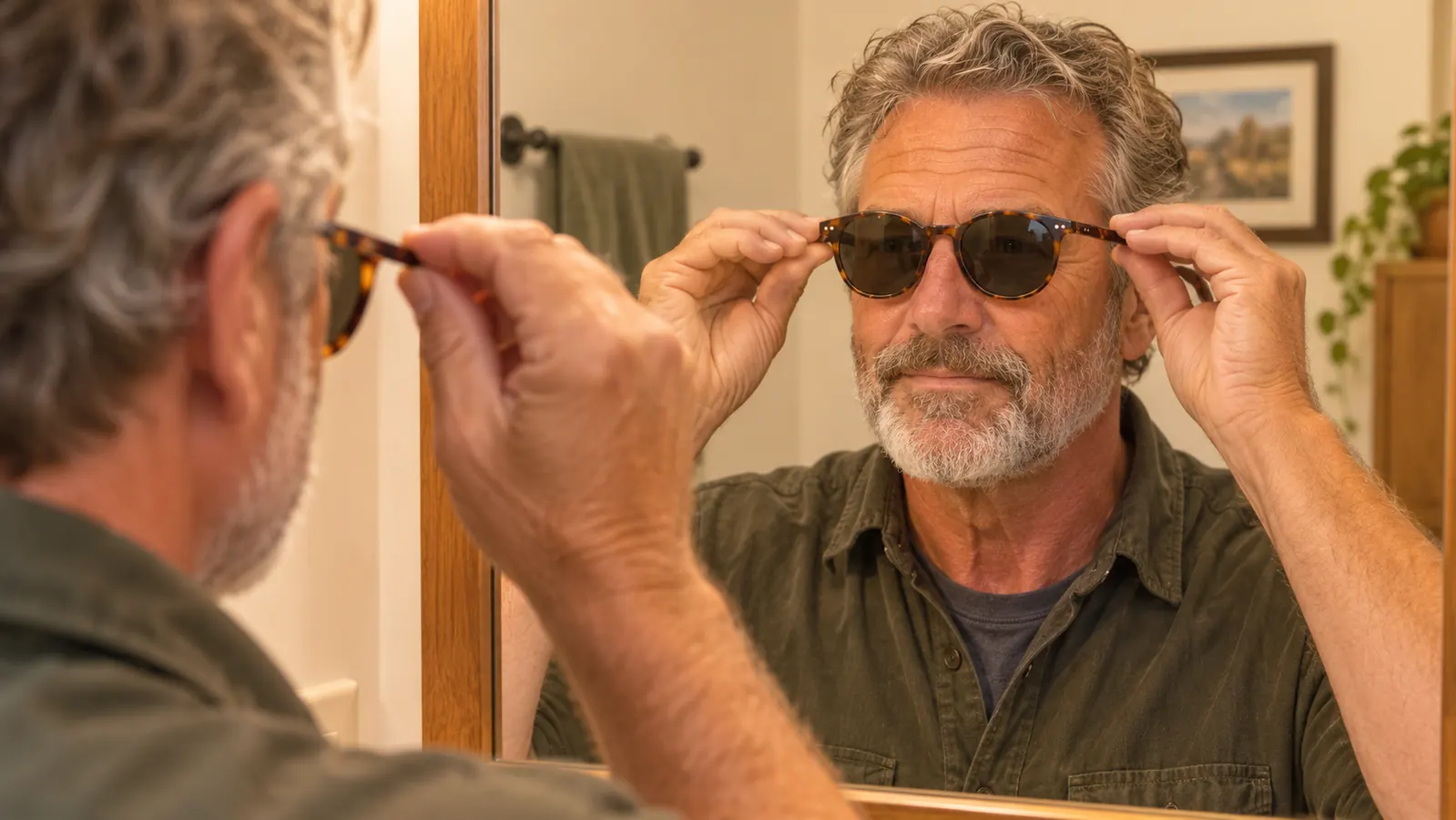
Step 2: Pick a shape that does the opposite
The old rule holds up: contrast works. Round face, angular frame. Square face, curved frame. Long face, a frame that does not add length. Heart shaped face, something with a little weight along the bottom to balance the forehead. This is not about flattering some standard. It is about keeping the frame from repeating what your face is already doing.
My face is long with a square jaw, so a round frame softens the corners and cuts the length. That is why the SOJOS small round pair worked on me and why a narrow rectangle made me look like a substitute teacher having a hard day. But if your face is genuinely round, a round frame will just echo it, and I would be lying to you if I said otherwise. A softly angular frame will do more for you.
Frame depth matters as much as outline, and people forget it. A shallow lens, the kind that barely covers the brow, looks sporty on the shelf and adds length to a long face. A deeper lens fills more of the face and shortens it. Try both on your own head before you decide, because a shape that works in a shallow lens can look wrong in a deep one. And keep size in mind: a small round frame is a small frame, so on a broad face it will look like it belongs to someone else. Look for a wider round or a rounded square instead.
Step 3: Check the width before anything else
Width is where most sunglasses fail, and it is the thing almost nobody checks. The frame front should be about as wide as the widest part of your face. Measure that with a ruler, then compare it to the frame width listed on the product page. If you are between sizes, go with the wider one for comfort, because a frame that is too narrow is the one that gives you a headache by ten in the morning.
Where you look for that number matters too. The frame front is the measurement you want, not the lens width and not the arm length. Listings often give all three, and the smallest of them is almost never the one you need. If a page gives you a single number and no explanation of what it measures, that is a page to close.
The temple press test takes ten seconds. Put the glasses on and press gently on the arms where they meet your head. If you feel them digging into your temples, they are too narrow. Now look down at the floor. If the glasses slide forward on your nose, they are too wide. Both of those are fit problems, not adjustment problems, and no amount of bending the arms will fix them. Here is the rule I use now: if a pair is not comfortable for the first five minutes, it will not be comfortable for a two hour drive. Sunglasses do not break in like shoes.

Step 4: Check the bridge, the brow line, and the cheeks
The bridge is the small piece over your nose, and it decides whether the frame sits where it should. The frame should rest on your nose without pinching and without sliding. If you have a low or wide bridge, look for a frame with a wider bridge area rather than one that sits up high and lets light in underneath. A pair that sits too high will have you pushing it down all day, and a pair that sits too low will have you pushing it up.
Then check the brow line. The top of the frame should roughly follow your eyebrows, sitting just below them or right along them. If the top of the frame cuts across the middle of your brow, the frame is sitting too low or the lens is too deep. If it floats well above your brow, it is too big, and it will feel heavy by the afternoon.
Finally, smile in the mirror. If the bottom of the frame lands on your cheeks, it will rub every time you talk or eat, and you will notice it in church when you are trying to look attentive. That is a height problem, not a you problem. Set the pair down and try another. Arm comfort belongs in this step as well: the arms should rest behind your ears without pressing on the bone. I have a stiff right shoulder from an old injury and I take glasses on and off a dozen times a morning, so I notice arm pressure in a way I did not used to. If you get a headache above your ears after an hour, the frame is wrong and it will not get better.
The pair I kept was not the prettiest one on the rack. It was the one that stayed put when I bent over to tie my shoe.
Step 5: Check what the lenses actually do
Fit gets you through the door, but the lenses are what you are paying for. Polarized lenses cut glare bouncing off car hoods, wet pavement, and water. You can test it in the store without any equipment: hold the glasses up, look at a reflective surface, and slowly turn them ninety degrees. If the glare shifts or darkens as you rotate, they are polarized. If nothing changes, they are not, no matter what the sticker said.
The SOJOS pair is polarized, and the listing states ultraviolet light protection with a UV protection coating on the lens. That combination is what I want for the drive to Charlotte to see Kate and the grandchildren, because glare on the interstate at four in the afternoon is the thing that makes my eyes tired before I get there. The listing also describes the form as wrap around with full frame coverage, and I can tell you that less light comes in at the sides than with my older frames.
One more check in the store. Look through the lenses at something with a straight edge, like a door frame, and move your head side to side. Cheap lenses will make that straight edge bend or swim near the edges. Good ones keep it straight almost to the rim. That distortion is what makes people feel queasy after twenty minutes in the car, and it has nothing to do with how dark the lens is. Do not buy a pair for the tint alone. A dark lens that is not polarized will still leave you squinting, and a very dark lens on a cloudy day makes the world look like a photograph printed too dark.
What Else Helps
Bring a photo of a pair you already own and like, even if it is old. It gives you a reference width without carrying a ruler around. Bring a friend who will tell you the truth. My daughter Kate is blunt in a way that has saved me money more than once, and if she says a pair makes me look like a bug, I believe her.
Go late in the day if you can, because your face is at its real size by then and you are less patient with discomfort, which is useful information. Wear the colors you actually wear. If your closet is navy, camel, gray, and black with one bright thing at a time, a loud frame will sit in the drawer and a classic frame will go with all of it. That is not boring. That is getting your money's worth.
A word about trends, since I am the wrong age to chase them and the right age to notice them. The oversized frames in every window right now are lovely on a tall woman with a long neck and miserable on a short one, and they slide down noses. If you love them, wear them. If you are buying them because everyone else has them, you will be back at the basket in a year.
Take care of whatever you buy and it will last. Clean the lenses with a microfiber cloth, not a shirttail, because a shirttail is how lenses get scratched. Do not leave them on the dashboard in July. Keep them in the same pocket of the same bag so you are not hunting for them in a parking lot. I have had the same SOJOS pair for a while now and the frames still sit straight, which is more than I can say for the three in the basket.
Start with the width, and the rest gets easy
If your last pair ended up in a drawer, the problem was probably the fit and not your face. Small round, polarized, full frame coverage, and a 4.4 average across nearly twenty thousand reviews.
Amazon Check Today's Price on Amazon →