

If you have ever fastened a watch and felt the band slide halfway around your wrist before you let go, you already know the problem. Most watches are built for a wrist bigger than mine and then sold to everybody. On a small wrist the case hangs over the edge, the band rattles, and the whole thing reads as borrowed from a grown-up. I have a six-inch wrist, a right shoulder that argues with me every morning, and very little patience for an accessory that needs two hands and a prayer. I have sent back more watches than I have kept, and the ones I kept all had the same three things: a band I could work one-handed, numerals I could read at arm's length, and a weight I stopped noticing by nine in the morning.
Here is the short answer, since you are busy. Start with the band and the numerals, not the case. If you want a name to go look at, the Timex Cavatina is the one I have kept. Timex builds it as a small oval analog watch with Arabic numerals, an expansion band, and a listed weight of 0.64 ounce, which is 18.14 grams. The movement is quartz, it runs on a battery that comes in the box, and it is the first watch in years that I can read without walking back to the kitchen for my glasses.
The watch I stopped taking off at my desk
Small oval case, Arabic numerals, expansion band, 0.64 ounce, battery included. Everything I needed and nothing that gets in the way.
Amazon Check Today's Price on Amazon →Five Steps, in the Order I Wish I Had Done Them
Step 1: Measure the Wrist You Have, Not the One in the Photograph
I keep a soft tape measure in the kitchen drawer now, and I use it before I look at a single photograph. Wrap it around the wrist bone, snug enough that it does not slide down, loose enough that you can work a fingertip underneath. Write the number down in inches and put it in your phone, because you will want it the next time you are tempted at eleven at night. Anything at 6.5 inches or under counts as a small wrist for watch sizing, and most of the women I know land between 6 and 6.5. Mine is 6.
Next, lay your arm flat on the table and look down at your wrist. The case should sit on that flat top without the lugs hanging in the air on either side. A watch that overhangs will catch on cardigan cuffs, seatbelt straps, and the handle of a grocery cart. It will also spin itself around all day, so you end up reading the dial upside down in the church pew, which is not the look anyone is going for.
Timex lists the Cavatina at 3.5 by 0.25 by 3 inches overall and 18.14 grams. The case is oval rather than round, and on a small wrist that shape follows the arm instead of perching on top of it. I notice it most in winter, because it slides under a coat sleeve rather than fighting it, and I notice it in the car, because it does not knock the console when I reach for the gear shift.
Step 2: Choose Numerals You Can Read Without Hunting for Your Glasses
There are two kinds of watch dials in this world. There are the ones with actual numbers on them, and there are the ones with little marks that assume you already know what time it is. At 58 I wear glasses for reading and nothing else, which means I am fine with a book and hopeless with a small dial at arm's length in a dim room. Arabic numerals, the ones that look like 1, 2, 3, solve this. They are the difference between glancing at your wrist and squinting at it.
Test the dial where you will actually use it, not under the bright light of a store counter. Stand in your own kitchen at seven in the morning with the overhead light off. Sit in the driver's seat of your car. Hold a steering wheel, then a hymnal, then a grocery list, and look at the watch from the distance your arm naturally sits. If you have to bring your wrist closer to your face, the dial is too small or too busy, no matter how lovely it looks in the photograph.
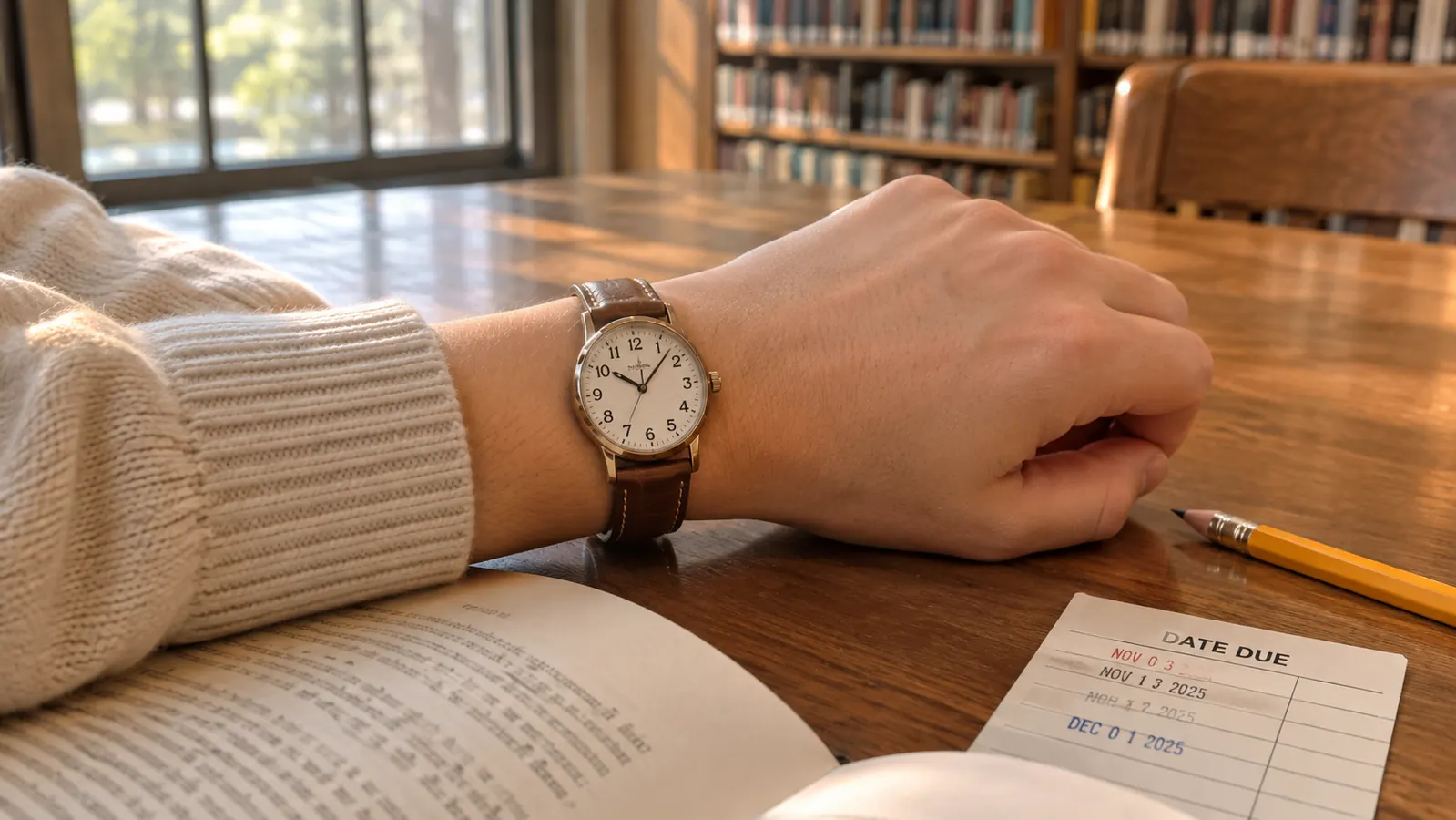
The Cavatina has Arabic numerals at the hours, an analog dial, and crystal detailing that catches a little light without turning the face into a glitter project. I can read the 12 from across the room, which sounds like a small thing until you have spent a year turning your wrist toward a window at the pharmacy counter while the line waits behind you.
Step 3: Get the Band Right, Because the Band Is the Watch
You touch the band twenty times a day and the case maybe twice. A buckle with a tiny tongue and a keeper loop is a two-handed operation, and if your shoulder is stiff or your hands are cold in December, it is a losing one. My right shoulder has been cranky since an old injury, so I put a watch on with my left hand and occasionally my teeth, and I would rather not make a habit of it.
The Timex Cavatina uses an expansion band, and Timex also lists a foldover, push-button closure. In practice that means the band opens wide, slides over your hand, and settles on the wrist without a buckle to line up. I put mine on one-handed at the kitchen counter most mornings with coffee in the other hand, and I have not dropped it yet. For anyone with arthritis or a shoulder that will not cooperate, this is the feature worth paying attention to.
Fit matters as much with an expansion band as it does with leather. You want it snug enough that the case stays on top of your wrist, and loose enough that it does not leave a red mark by lunch. If it spins freely, it is too big. If it pinches the fine hair on your arm, it is too tight or a link is catching. Buy from somewhere with a real return window and wear it around the house for a week before you decide to keep it.
Step 4: Weigh It, Literally
A heavy watch on a small wrist has one job and it does it badly, which is to rotate. The case swings to the outside of your arm every time you lift a bag of groceries or type a sentence, and you spend the day pushing it back into place. Weight is the specification nobody puts in the headline, and it matters more than most of what does get in the headline.
The Cavatina is listed at 0.64 ounce, or 18.14 grams, which is lighter than my car keys. I notice it when I put it on in the morning and then I do not notice it again, and that is the highest compliment I can pay a piece of jewelry. If a watch is heavy enough that you are aware of it at three in the afternoon, it will be in the drawer by the end of the month. That is not a character flaw. It is physics.
Step 5: Decide What You Will Actually Do While Wearing It
This is the step where I stop being polite. The Cavatina is listed as not water resistant, and I mean that plainly. Do not wash dishes in it. Do not wear it into the shower. Do not wear it to the pool with the grandchildren, and do not leave it on while you scrub a roasting pan. A watch that lives on your wrist all winter and then takes one plunge into the sink is a watch that stops, and no amount of good intentions will restart it.
That said, for walking downtown, running errands, church on Sunday, and the drive to Charlotte to see my daughter, it is exactly right. Timex lists walking as the sport type, and I appreciate the honesty of that. It is a dressy little everyday watch, not a sports watch, and the crystal detailing tells you so before the specification sheet ever does.
It runs on a battery, the battery is included, and the movement is quartz, so there is nothing to wind and nothing to set but the time. When it eventually stops, a jeweler can change the battery while you wait. Write the date on the back of the little card in the box so you are not guessing three years from now. Mine has run without complaint since the day I opened the package, and it has stayed accurate to the minute against the clock on my stove.
I can read the 12 without my glasses, and at 0.64 ounce I forget I have it on until the moment I need it.

Where the Cavatina Falls Short
The water resistance is the big one, and I will not pretend otherwise. Not water resistant means exactly that, and I would not test it. The expansion band is comfortable, but expansion bands loosen over years of daily wear and there is no buckle to tighten. If it gets sloppy, a jeweler can sometimes remove a link and sometimes cannot. The crystal detailing is decoration rather than armor, and it will collect lint if you store the watch in a drawer with a wool scarf.
It is also a battery watch, which means one small errand every few years and a real chance of discovering it stopped on a Sunday morning when you are already late for choir. I keep a spare battery in the kitchen drawer now, which is less elegant than a wind-up and a good deal less fuss. If a mechanical movement matters to you, this is not that watch.
What Else Helps
Buy from a seller with an easy return policy, and keep the box and the tag for two weeks. Wear the watch at home first, then to the grocery store, then to church. You will learn more in three days of real life than in an hour of reading listings. If you have a jeweler downtown you trust, have them look at the band fit before you commit. Mine adjusted a bracelet for me for the price of a thank-you, and he has told me honestly, more than once, when a watch was not worth keeping.
Keep a small dish by the door for the watch, and take it off before you touch water. If your hands are cold and stiff in the morning, the expansion band is the feature you will appreciate most, more than the dial and more than the finish. And if you wear reading glasses, check the numerals in the room where you will actually look at the watch, at the distance you will actually hold it. That single test has saved me more return shipping than any review I have ever read.
If your wrist is small and your patience is short
Small oval case, Arabic numerals, expansion band, 0.64 ounce, battery included. Take it off before the dishes and it will keep good time for years.
Amazon Check Today's Price on Amazon →