

Here is the short answer. If your wallet lives in a handbag and you want to see every card at once without digging, the Fossil Logan Leather Tab Clutch is the easier daily carry. If you want something that folds in half and disappears into a coat pocket, a plain bifold does that better and always will. I carried the Logan for six weeks in my everyday bag, through choir practice on Sundays, a drive down to Charlotte to see my daughter, and the ordinary Tuesday errands that make up most of a life. I have also owned bifolds for thirty years, so this is not a contest between a good wallet and a bad one. It is a question of what you are asking the thing to do.
Most comparisons of these two shapes get bogged down in craftsmanship, as if stitched edges were the deciding factor. They are not. Both a clutch wallet and a bifold will hold cards and cash until the stitching gives out, and at fifty-eight I have learned that the wallet you actually enjoy using is the one that fits the way you leave the house. I walk downtown most mornings with a small bag over my left shoulder, because my right shoulder has been stiff since an old injury and I have stopped pretending otherwise. That single detail rules out more accessories than any trend report ever will. So the honest comparison here is about weight, access, and how much you are willing to dig.
| Fossil Logan Tab Clutch | A Bifold Wallet | |
|---|---|---|
| What it holds | Sixteen compartments, so cards, cash and receipts each get a place | Usually a card stack and a bill slot, sometimes a coin pocket |
| Getting a card out | Opens flat, so every slot is visible at once | You fold it open and flip through a stack |
| How you carry it | As its own clutch, in hand or inside a larger bag | Folded in half, in a pocket or a bag pocket |
| Room it takes in a small bag | 6.73 by 3.5 by 0.75 inches, 4.4 ounces | Smaller footprint, but thicker through the middle |
| RFID blocking | Listed as RFID blocking | Only if you pick one built with it |
| Warranty | The listing states no warranty | Varies by maker, some carry a limited one |
| Best for | Carrying as a clutch on its own, phone in the other hand | Traveling light with pockets and nothing else |
What the Measurements Mean Once It Is in Your Bag
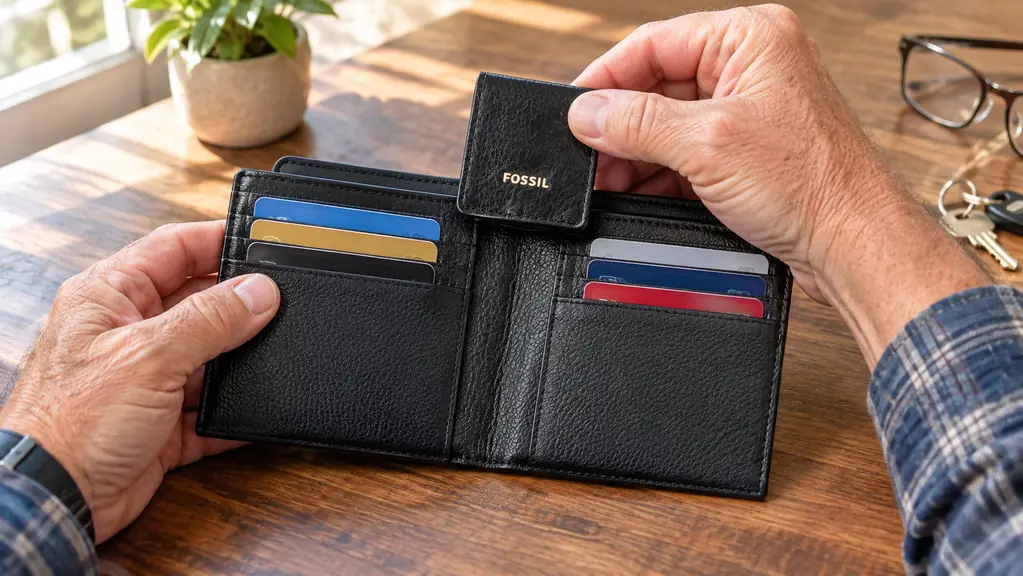
The Logan is 6.73 inches long, 3.5 inches tall and three quarters of an inch thick, and it weighs 4.4 ounces. Those are the published numbers, not my guesses with a tape measure. What they mean in the hand is that it runs roughly the length of my palm and fingers, so it rests against the wrist comfortably when I carry it by the tab instead of dropping it into a bag. Three quarters of an inch is the number I would watch if you are deciding. That is thin enough to slide into the inner pocket of a tote without turning the bag into a brick, and thick enough that the snap is not fighting a stack of cards every time you close it.
I tested those numbers against the bag I actually carry, a navy leather tote with a lined inner pocket about seven inches across at the mouth. The wallet slides in and sits flat with roughly a quarter inch to spare, which reads as tight on paper and is not, because leather gives a little as it warms up in a room. What it will not do is drop into the shallow slip pocket on the outside, the one meant for a phone. I tried it once out of habit and it stood up out of the pocket like a book on a shelf. Knowing that on day one saved me six weeks of shoving at it in parking lots.
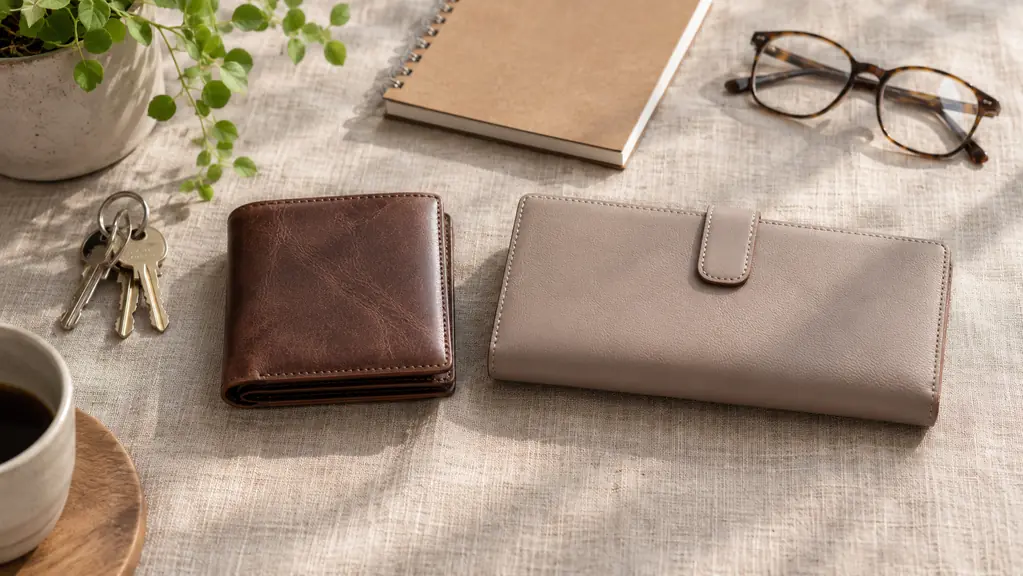
Tom's old bifold lives in the kitchen drawer and comes out for funerals and tax appointments. Folded and loaded, it swells in the middle the way a bifold does, and it does not sit flat on a table. That swell is the whole difference in one sentence. A bifold is built around a pocket. A clutch is built around a hand.
The other number worth knowing is sixteen. That is how many compartments the Logan carries, and it is the figure that separates it from nearly every bifold on a shelf. Sixteen sounds like a boast until you have stood at a pharmacy counter with your reading glasses pushed up, holding a wallet open in one hand while the line builds behind you.
What Six Weeks of Real Use Looked Like
I put the Logan in my everyday bag on a Monday and left it there. By the second week I had stopped reaching for the little card case I used to keep in the side pocket, which surprised me. The wallet sat flat against the lining, and because it opens all the way I could hold it in one hand and pull a card with the other, which matters when the other hand is holding a grocery basket.
Choir practice is where it proved itself. I keep a folded check for the offering envelope and a couple of loyalty cards in there alongside the usual, and on a Sunday morning in a crowded fellowship hall I never once had to set my bag down and root through it. The snap closure held through being dropped into a tote with a hymnal and a water bottle, and nothing worked its way out. That is a low bar, I know, but plenty of wallets fail it.
There was a Thursday in the third week that sums the whole experiment up. I had a pharmacy pickup, a stop at the bank drive-through, and a return at the hardware store, three errands in a row where you have to produce something out of a wallet. In the old arrangement my cards lived in three places: the pharmacy card in a card case, the debit card loose in the bag, the receipt folded into a coat pocket. With the Logan it was one object, opened once at each counter. By the time I pulled back into my own driveway I realized I had not set the bag down a single time.
The drive to Charlotte is about two hours, and I stopped once at a rest area. The Logan came in with me instead of staying in the bag on the seat, because carrying it by the tab is no harder than carrying a phone. That is the quiet advantage of a clutch shape. It can leave the house on its own. A bifold can too, in a pocket, but only if you have a pocket, and most of my warmer weather clothes do not.
Where the Fossil Logan Wins
Access is the first thing. The wallet opens flat, so you are not flipping through a stack hunting for the dental card while a receptionist waits. Everything is in front of you at once. For anyone whose close-up vision has gone the way mine has, that is not a small convenience. It is the difference between a calm transaction and a fumbled one. The snap keeps it shut in a bag full of keys and a hairbrush, and in six weeks I never had a card slip out.
The second thing is the RFID blocking the listing describes. I am not going to pretend I tested it with equipment in my kitchen. What I can tell you is that it is one less thing to think about in a crowded rest stop. The tab is the third. Carrying a wallet by a tab rather than fishing for it in a bag is easier on a shoulder that already complains, and it means I can leave the bigger bag in the car when I run in for one thing. Small dignities, but at this age I will take them.
One more point belongs here, and it took me a while to name it. The Logan feels like a piece rather than a utility. On a Saturday evening when Tom and I went out for an early dinner, I left the tote at home and carried the wallet alone with my phone in the other hand, and it read as a clutch rather than as a wallet doing an impression of one. Fossil built it for that job, and it shows in a way a folded wallet simply cannot manage. A bifold taken to dinner looks like a bifold taken to dinner.
A bifold is built around a pocket. A clutch is built around a hand. Once you see it that way, the rest of the comparison sorts itself out.
Where a Bifold Wallet Wins
Size, plainly. A bifold folded shut takes less room in a small bag than the Logan's flat rectangle, and because it is smaller in two dimensions it slips into a jacket pocket without a second thought. On a morning walk where I want nothing but keys, phone and one card, the bifold is the thing that disappears. The Logan asks to be carried, one way or another, and there is no version of it that vanishes into a pocket.
Simplicity is the second win and it is not a small one. A bifold has fewer parts to wear out: no snap to loosen, no tab to fray, no sixteen slots to keep tidy. It is also easy to find and easy to replace. On the warranty question the Logan takes the loss outright, because the listing states no warranty at all. If a stitched edge fails in year three, that is between you and a repair shop. A cheap bifold failing in year three is a shrug and a replacement.
See the Wallet That Opens Flat in Your Hand
The Logan holds sixteen compartments, closes with a snap, and is listed as RFID blocking. It is the one I reach for when the bag comes with me.
Amazon Check Today's Price on Amazon →The Compartment Question
Sixteen compartments are a blessing or a trap depending on whether you assign them. Left loose, they fill with receipts and expired coupons and you are back to digging, just in a bigger container. What worked for me was deciding once: library card and grocery card in the slots nearest the snap, since those are the two I hand over most, medical cards in the middle where they stay protected, and the long pocket for bills and the church envelope. Once the assignment was made I stopped thinking about it, which is the highest compliment I can pay a wallet.
The trap is treating it as a filing cabinet. If you keep every receipt, no wallet will save you, and a bifold will at least force you to throw things away. The Logan is forgiving enough to let you accumulate. That is a real tradeoff and I would rather name it than pretend the extra room is pure gain.
The other habit worth forming is emptying it once a month. I do it on the first Saturday, the same morning I sit down with the checkbook, and it takes about four minutes. Receipts out, expired coupons out, the two cards I never actually use moved to the back. Left alone for three months, any flat wallet does what a flat surface always does and collects. The difference is that a wallet you can see into at a glance is easier to clean out than a stack you have to fan through, so the chore stays small instead of becoming a project.
Who Should Buy Which
Buy the Fossil Logan if your wallet lives in a bag, if you carry more than four cards, if you have ever held up a line looking for the right one, or if you want one piece that passes as a clutch when you go out to dinner and leave the tote at home. It suits someone who wants things to last and does not mind a little structure. It also suits anyone whose hands or shoulders make digging unpleasant, because a flat open wallet is easier to manage than a folded one.
Buy a bifold if you travel light by habit, if you keep three cards and a few bills and nothing else, if you are hard on things and would sooner replace than repair, or if you want a wallet that disappears into a pocket. That is not the lesser choice, it is a different job. If you are honestly somewhere in the middle, keep the bifold for travel and put the Logan in the bag you carry every day, which is what I ended up doing.
One Wallet, Sixteen Compartments, No Digging
If the bag comes with you most days, the Logan is the one that earns its place. A 4.6 rating across more than three thousand reviews is not proof of anything, but it is worth a look.
Amazon Check Today's Price on Amazon →